
Please Buy the PDF full text in English, along with translations in Chinese, Hindi, Indonesian, Arabic, Spanish, Portuguese, and French.
Glioblastoma is the deadliest type of brain tumor with limited effective therapies over decades. Its growth and recurrence rely heavily on glioblastoma stem cells (GSCs), which resist standard chemo-radiotherapy. Bone Morphogenetic Protein 4 (BMP4) can push these malignant stem cells to mature and lose their tumor-forming ability in lab and animal models. This paper reports the world’s first human Phase 1 trial testing locally injected human recombinant BMP4 (hrBMP4) as a differentiation-based anti-cancer therapy for recurrent glioblastoma.
This international multi-center open-label trial used a standard 3+3 dose-escalation design, enrolling 15 adult patients whose glioblastoma had returned after standard chemoradiation. Eligible patients had decent daily function (Karnofsky score >70) and limited brain swelling. Doctors implanted fine catheters into and around tumors for Convection Enhanced Delivery (CED)—a slow, pressure-driven infusion that spreads drugs deep into brain tissue better than regular injections. Five dose groups (0.5 mg to 18 mg hrBMP4, three patients each) received continuous infusion over 4–6 days. Researchers tracked safety, maximum tolerable dose (MTD), blood hrBMP4 levels, MRI tumor changes, survival, and quality of life for up to 57 months.
The treatment proved very safe overall. No drug-related severe toxicities or dose-limiting side effects emerged, so MTD was not reached. Most mild-to-moderate symptoms (headache, vomiting, weakness) stemmed from catheter surgery or steroid drugs, not hrBMP4. Only three patients had temporarily elevated blood hrBMP4 that returned to normal within four weeks without harm.
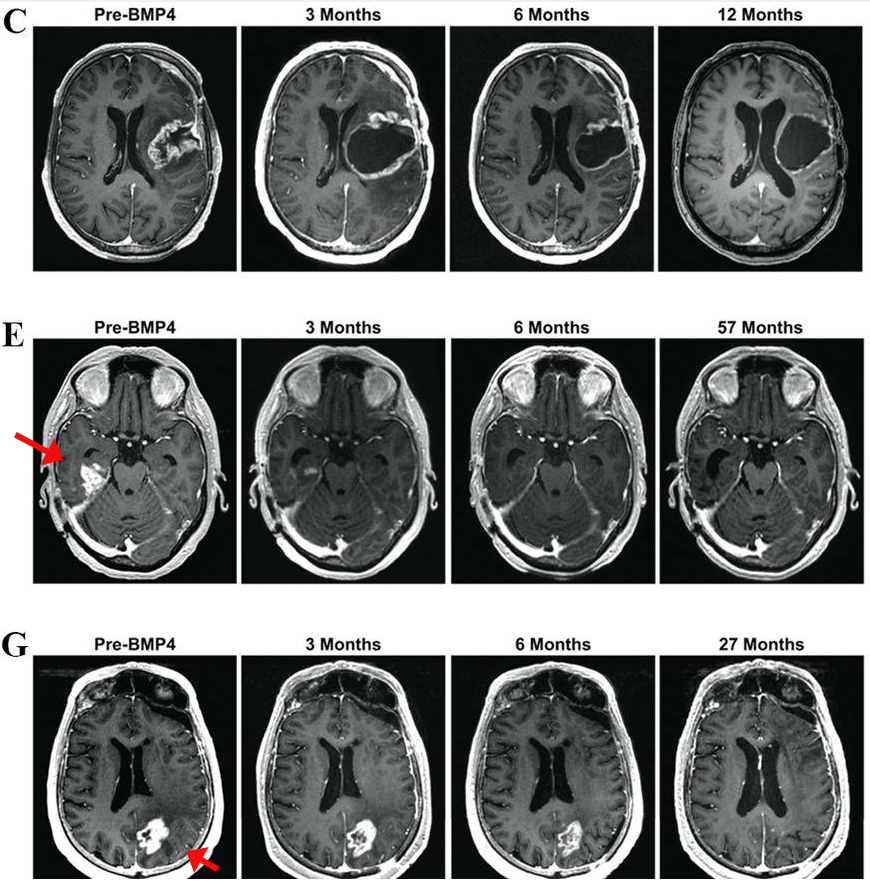
Notably, 3 out of 15 patients showed lasting tumor shrinkage, including two complete local tumor responders with exceptional long-term survival. Patient 2 received the lowest 0.5 mg hrBMP4 dose for a second recurrent temporal glioblastoma. After infusion, the treated tumor slowly shrank steadily over 12 months with no new tumor growth. At the 57-month follow-up, the patient remained clinically stable with improved movement and balance, and never needed extra chemo or surgery afterward. Patient 15 got the highest 18 mg hrBMP4 dose for a treatment-resistant parietal lobe recurrence. The lesion regressed gradually over 18 months and achieved full radiological clearance. Thirty months post-treatment, this injected tumor area stayed completely gone, even though a separate untreated frontal tumor later progressed. The third responder only had partial tumor shrinkage before later progression. Another key finding: tumor regrowth almost always happened outside brain regions covered by hrBMP4 infusion, while drug-permeated zones rarely saw new tumor growth. Median overall survival across all patients hit 7 months, longer than the typical 5.6 months from common second-line lomustine chemotherapy.
This pioneering first-in-human study confirms local hrBMP4 via CED is safe and tolerable for recurrent glioblastoma. The two long-term complete remissions strongly validate differentiation therapy targeting GSCs. Its main limitations are incomplete tumor coverage by CED catheters and lack of pre-trial molecular patient screening. The promising anti-tumor signals support launching larger Phase 2 trials to formally test hrBMP4’s therapeutic power, with technical improvements to boost drug coverage and predictive biomarkers to select patients most likely to respond.
中国用户请通过支付宝购买PDF英语全文及其中文翻译件。
hrBMP4局部给药治疗复发性胶质母细胞瘤: 2例完全肿瘤消失
胶质母细胞瘤是恶性程度最高的脑肿瘤,数十年来有效治疗手段十分匮乏。肿瘤的增殖与复发高度依赖胶质母细胞瘤干细胞(GSCs),这类细胞能够耐受标准放化疗。细胞及动物实验证实,骨形态发生蛋白4(BMP4)可诱导恶性干细胞分化成熟,使其丧失成瘤能力。本文为全球首项Ⅰ期人体临床试验,评估局部输注重组人骨形态发生蛋白4(hrBMP4)作为分化型抗肿瘤疗法,用于治疗复发性胶质母细胞瘤的效果。
本研究为国际多中心、开放标签临床试验,采用经典3+3剂量递增方案,共纳入15名经标准放化疗后肿瘤复发的成年患者。入组患者日常活动能力良好(卡氏功能评分>70分),且肿瘤占位引发的脑组织水肿程度较轻。手术中将细导管植入肿瘤内部及瘤周脑组织,采用对流增强递送技术(CED)给药:该技术依靠持续低压缓慢输注药物,相比常规注射能让药物更深、更广地渗透脑组织。试验设置5个剂量组,每组3名患者,给药剂量区间为0.5毫克至18毫克,持续输注4至6天。研究人员开展最长达57个月的随访,监测药物安全性、最大耐受剂量(MTD)、患者外周血hrBMP4浓度、磁共振(MRI)肿瘤影像变化、生存期及生活质量。
整体而言,该治疗方案安全性良好。试验未出现与药物相关的严重不良反应,也未观测到剂量限制性毒性,因此未确定最大耐受剂量。多数轻、中度不良反应(头痛、呕吐、肢体无力)均由导管植入手术或激素类辅助药物引发,并非hrBMP4本身所致。仅3名患者输注后外周血hrBMP4浓度短暂升高,4周内自行回落至基线水平,且未伴随任何毒副作用。
试验中15名患者里有3人出现持久的肿瘤缩小,其中2例实现局部肿瘤完全消退,获得超长生存期,值得重点关注。2号患者为颞叶胶质母细胞瘤二次复发,接受最低剂量0.5mg hrBMP4治疗。给药后,病灶在12个月内持续缓慢缩小,无新发肿瘤;随访至57个月时,患者身体状态稳定,肢体活动、行走平衡能力较治疗前显著改善,全程无需追加化疗或二次手术。15号患者顶叶肿瘤多次化疗无效,属于复发难治病灶,接受最高剂量18mg hrBMP4输注。病灶在18个月内逐步消退,影像学评估达到完全缓解;治疗30个月后,该给药区域肿瘤仍完全消失,仅患者颅内另一处未给药的额叶病灶后续出现进展。第三名应答患者仅实现肿瘤部分缩小,后续病情仍出现进展。另一关键结果:肿瘤复发几乎全部出现在hrBMP4药物渗透范围之外,药物浸润区域极少发生肿瘤再生。所有患者中位总生存期为7个月,优于临床常用二线化疗药洛莫司汀5.6个月的中位生存期。
这项开创性首人体试验证实,经对流增强递送技术局部输注hrBMP4用于复发性胶质母细胞瘤安全、耐受性佳。两例长期肿瘤完全缓解的病例,有力证实了靶向胶质母细胞瘤干细胞的分化疗法具备临床潜力。研究存在两点主要局限:对流给药导管无法实现肿瘤全域覆盖,且入组前未依据肿瘤分子分型筛选患者。本次试验展现出可观的抗肿瘤疗效信号,支持开展更大规模Ⅱ期临床试验,系统验证hrBMP4的治疗价值;后续可优化给药技术提升药物覆盖范围,同时筛选生物标志物,精准筛选更易从该疗法获益的患者。
PDF अंग्रेजी पूर्ण पाठ और उसका हिंदी अनुवाद खरीदें।
पुनरावृत्त ग्लियोब्लास्टोमा के लिए स्थानीय hrBMP4 वितरण परीक्षण
ग्लियोब्लास्टोमा मस्तिष्क का सबसे घातक ट्यूमर है, जिसके लिए दशकों से प्रभावी उपचार के बहुत कम विकल्प उपलब्ध हैं। इसकी वृद्धि और पुनरावृत्ति मुख्य रूप से ग्लियोब्लास्टोमा स्टेम कोशिकाओं (GSCs) पर निर्भर करती है, जो मानक कीमो-रेडियोथेरेपी का प्रतिरोध करती हैं। प्रयोगशाला और पशु मॉडल में बोन मॉर्फोजेनेटिक प्रोटीन 4 (BMP4) इन घातक स्टेम कोशिकाओं को परिपक्व होने के लिए प्रेरित कर सकता है और उनकी ट्यूमर बनाने की क्षमता समाप्त कर सकता है। यह शोध पत्र पुनरावृत्त ग्लियोब्लास्टोमा के लिए विभेदन-आधारित कैंसर विरोधी चिकित्सा के रूप में स्थानीय रूप से इंजेक्ट मानव पुनर्संयुक्त BMP4 (hrBMP4) का परीक्षण करने वाला विश्व का पहला मानव प्रथम चरण (फेज 1) परीक्षण प्रस्तुत करता है।
यह अंतर्राष्ट्रीय बहु-केंद्र ओपन-लेबल परीक्षण मानक 3+3 खुराक वृद्धि डिजाइन का उपयोग करता है, जिसमें 15 वयस्क रोगी भर्ती किए गए जिनका ग्लियोब्लास्टोमा मानक कीमोरेडिएशन के बाद दोबारा उभर गया था। पात्र रोगियों का दैनिक कार्य क्षमता अच्छी थी (करनोफ्स्की स्कोर >70) और मस्तिष्क में सूजन सीमित थी। डॉक्टरों ने ट्यूमर के अंदर और आसपास पतली कैथेटर लगाए, जिससे कन्वेक्शन एनहांस्ड डिलीवरी (CED) की तकनीक अपनाई गई। यह धीमा, दबाव-चालित संक्रमण तकनीक सामान्य इंजेक्शन की तुलना में दवा को मस्तिष्क के ऊतकों में गहराई तक फैलाती है। पांच खुराक समूह (प्रत्येक में तीन रोगी) थे जिन्हें 0.5 मिलीग्राम से 18 मिलीग्राम तक hrBMP4 की अलग-अलग खुराकें दी गईं, जिन्हें लगातार 4 से 6 दिनों तक संक्रमित किया गया। शोधकर्ताओं ने सुरक्षा, अधिकतम सहनीय खुराक (MTD), रक्त में hrBMP4 का स्तर, MRI से ट्यूमर में बदलाव, जीवित रहने की अवधि और जीवन की गुणवत्ता को अधिकतम 57 महीनों तक ट्रैक किया।
कुल मिलाकर यह उपचार बहुत सुरक्षित साबित हुआ। कोई भी दवा से जुड़ा गंभीर विषाक्त प्रभाव या खुराक-सीमित दुष्प्रभाव नहीं देखा गया, इसलिए अधिकतम सहनीय खुराक निर्धारित नहीं हो सकी। अधिकांश हल्के से मध्यम लक्षण (सिरदर्द, उल्टी, शरीर का कमजोर होना) कैथेटर सर्जरी या स्टेरॉयड दवाओं के कारण थे, न कि hrBMP4 के कारण। केवल तीन रोगियों के रक्त में hrBMP4 का स्तर अस्थायी रूप से बढ़ा था, जो चार सप्ताह के अंदर बिना किसी नुकसान के सामान्य हो गया।
उल्लेखनीय बात यह है कि 15 में से 3 रोगियों में ट्यूमर में लंबे समय तक सिकुड़ाव देखा गया, जिनमें से दो में पूर्ण स्थानीय ट्यूमर उन्मूलन हुआ और वे असाधारण रूप से लंबे समय तक जीवित रहे। रोगी 2 को दूसरी बार पुनरावृत्त टेम्पोरल ग्लियोब्लास्टोमा के लिए सबसे कम 0.5 मिलीग्राम hrBMP4 खुराक दी गई। संक्रमण के बाद उपचारित ट्यूमर धीरे-धीरे 12 महीनों तक लगातार सिकुड़ता रहा और कोई नया ट्यूमर नहीं उभरा। 57 महीने के अनुवर्ती परीक्षण के समय यह रोगी चिकित्सकीय रूप से स्थिर रहा, उसकी गति और संतुलन में सुधार हुआ, और उसे बाद में कोई अतिरिक्त कीमोथेरेपी या सर्जरी की आवश्यकता नहीं पड़ी। रोगी 15 को उपचार प्रतिरोधी पैरिएटल लोब के पुनरावृत्त ट्यूमर के लिए उच्चतम 18 मिलीग्राम hrBMP4 खुराक दी गई। यह घाव धीरे-धीरे 18 महीनों तक कम हुआ और पूर्ण रेडियोलॉजिकल उन्मूलन प्राप्त हुआ। उपचार के 30 महीने बाद भी यह इंजेक्ट क्षेत्र पूरी तरह से ट्यूमर मुक्त रहा, भले ही अलग से अनुपचारित फ्रंटल लोब का ट्यूमर बाद में बढ़ गया। तीसरे प्रतिक्रियाशील रोगी में केवल आंशिक ट्यूमर सिकुड़ाव देखा गया था, जिसके बाद ट्यूमर फिर बढ़ गया। एक अन्य मुख्य निष्कर्ष यह है कि ट्यूमर का पुनर्विकास लगभग हमेशा मस्तिष्क के उन क्षेत्रों के बाहर हुआ जहां hrBMP4 पहुंचा था, जबकि दवा से भरे क्षेत्रों में नया ट्यूमर विकसित होने के मामले बहुत कम थे। सभी रोगियों का औसत कुल जीवित रहने का समय 7 महीने था, जो सामान्य दूसरी पंक्ति की लोमुस्टीन कीमोथेरेपी के विशिष्ट 5.6 महीनों की तुलना में अधिक है।
यह अग्रणी मानव प्रथम चरण का अध्ययन पुष्टि करता है कि CED के माध्यम से स्थानीय hrBMP4 पुनरावृत्त ग्लियोब्लास्टोमा रोगियों के लिए सुरक्षित और सहनीय है। दो लंबी अवधि तक पूर्ण ट्यूमर उन्मूलन के मामले स्टेम कोशिकाओं को लक्षित करने वाली विभेदन चिकित्सा की वैधता को मजबूत करते हैं। इस अध्ययन की मुख्य सीमाएं हैं CED कैथेटर से ट्यूमर का अधूरा कवरेज और परीक्षण शुरू होने से पहले रोगियों के आणविक वर्गीकरण की कमी। ट्यूमर विरोधी आशाजनक परिणाम बड़े दूसरे चरण (फेज 2) परीक्षण शुरू करने का समर्थन करते हैं, जिसमें hrBMP4 की चिकित्सीय क्षमता को औपचारिक रूप से जांचा जाएगा। साथ ही तकनीकी सुधारों से दवा का ट्यूमर कवरेज बढ़ाया जाएगा और पूर्वानुमानित बायोमार्करों की मदद से उन रोगियों का चयन किया जाएगा जिनके इस उपचार से लाभ होने की सबसे अधिक संभावना है।
ट्रांसलेशन नोट
- यह मानक देवनागरी हिन्दी (भारतीय प्रयुक्त) अनुवाद है, चिकित्सा शब्दावली को भारतीय चिकित्सा पाठ्यपुस्तकों में प्रचलित शब्दों से लिखा गया है।
- तकनीकी शब्द जैसे CED, hrBMP4, MRI, Karnofsky, Lomustine को वही रखकर हिन्दी में व्याख्या दी गई है।
- चिकित्सा संबंधी संज्ञाएं (ट्यूमर, स्टेम कोशिका, कीमोथेरेपी, रेडियोथेरेपी) भारतीय अस्पतालों में उपयोगी शब्दावली से अनुवादित हैं।
Membeli teks lengkap PDF dalam bahasa Inggris dan terjemahan bahasa Indonesia.
Uji Coba Pemberian Lokal hrBMP4 untuk Glioblastoma Berulang
Glioblastoma merupakan jenis tumor otak paling mematikan, dan selama puluhan tahun pengobatan efektif untuk penyakit ini masih sangat terbatas. Pertumbuhan serta kekambuhan tumor ini sangat bergantung pada sel batang glioblastoma (GSC), yang tahan terhadap kemoterapi dan radioterapi standar. Protein Morfogenetik Tulang 4 (BMP4) terbukti mampu mendorong sel batang ganas ini untuk matang dan kehilangan kemampuan membentuk tumor, berdasarkan hasil penelitian laboratorium dan model hewan. Artikel ini melaporkan uji coba Fase 1 pertama di dunia yang menguji rekombinan BMP4 manusia (hrBMP4) yang disuntikkan secara lokal sebagai terapi antikanker berbasis diferensiasi pada pasien glioblastoma berulang.
Uji coba terbuka lintas pusat internasional ini menggunakan desain peningkatan dosis standar 3+3, dengan merekrut 15 pasien dewasa yang glioblastomanya kambuh setelah menjalani kemoradioterapi standar. Pasien yang memenuhi syarat memiliki fungsi aktivitas sehari-hari yang baik (skor Karnofsky >70) dan pembengkakan otak yang terbatas. Dokter memasang kateter halus ke dalam dan di sekitar tumor untuk Metode Pemberian Konveksi Terarah (CED)—infus lambat bertekanan yang dapat menyebarkan obat jauh ke dalam jaringan otak lebih efektif dibanding suntikan biasa. Terdapat lima kelompok dosis hrBMP4 (0,5 mg hingga 18 mg, masing-masing berisi tiga pasien) yang menerima infus berkelanjutan selama 4–6 hari. Peneliti memantau aspek keamanan, dosis toleransi maksimal (MTD), kadar hrBMP4 dalam darah, perubahan tumor melalui MRI, tingkat kelangsungan hidup, serta kualitas hidup pasien hingga masa tindak lanjut 57 bulan.
Secara keseluruhan, pengobatan ini sangat aman. Tidak ditemukan efek racun berat terkait obat maupun efek samping pembatas dosis, sehingga batas dosis toleransi maksimal tidak tercapai. Sebagian besar gejala ringan hingga sedang (sakit kepala, muntah, kelemahan anggota tubuh) berasal dari prosedur pemasangan kateter atau obat steroid, bukan dari hrBMP4. Hanya tiga pasien yang mengalami peningkatan sementara kadar hrBMP4 dalam darah, namun kadar tersebut kembali normal dalam waktu empat minggu tanpa menimbulkan bahaya.
Yang patut diperhatikan, 3 dari 15 pasien mengalami penyusutan tumor yang bertahan lama, termasuk dua pasien dengan respons lengkap tumor lokal dan kelangsungan hidup jangka panjang yang luar biasa. Pasien nomor 2 menerima dosis hrBMP4 terendah sebesar 0,5 mg untuk glioblastoma temporal yang kambuh kedua kalinya. Setelah infus, tumor yang dirawat perlahan menyusut secara konsisten selama 12 bulan tanpa muncul pertumbuhan tumor baru. Pada tindak lanjut bulan ke-57, pasien ini tetap stabil secara klinis dengan peningkatan fungsi gerak dan keseimbangan tubuh, serta tidak pernah memerlukan kemoterapi atau operasi tambahan setelahnya. Pasien nomor 15 menerima dosis tertinggi 18 mg hrBMP4 untuk kekambuhan di lobus parietal yang resisten terhadap pengobatan. Lesi tumor perlahan memudar selama 18 bulan dan mencapai pembersihan penuh yang terlihat pada hasil radiologi. Hingga 30 bulan pasca pengobatan, area tumor yang diinfus tetap hilang sepenuhnya, meskipun tumor terpisah di lobus frontal yang tidak dirawat kemudian berkembang. Pasien ketiga hanya mengalami penyusutan sebagian tumor sebelum akhirnya tumor kembali berkembang. Temuan penting lainnya: kekambuhan tumor hampir selalu muncul di area otak yang tidak terjangkau oleh infus hrBMP4, sedangkan wilayah yang terpenetrasi obat jarang sekali mengalami pertumbuhan tumor baru. Median kelangsungan hidup keseluruhan seluruh pasien mencapai 7 bulan, lebih lama dibandingkan rata-rata 5,6 bulan dari lomustin, kemoterapi lini kedua yang umum digunakan.
Studi pertama pada manusia yang perintis ini membuktikan bahwa pemberian hrBMP4 secara lokal melalui CED aman dan dapat ditoleransi pasien glioblastoma berulang. Dua kasus remisi lengkap jangka panjang secara kuat memvalidasi konsep terapi diferensiasi yang menargetkan sel batang glioblastoma. Keterbatasan utama penelitian ini adalah cakupan tumor yang tidak sempurna oleh kateter CED serta tidak adanya skrining molekuler pasien sebelum penelitian. Sinyal efek antikanker yang menjanjikan mendukung pelaksanaan uji coba Fase 2 skala besar untuk menguji efektivitas terapi hrBMP4 secara formal, disertai perbaikan teknis guna memperluas cakupan obat dan biomarker prediktif untuk memilih pasien yang paling berpotensi merespons pengobatan.
شراء النص الكامل باللغة الإنجليزية بصيغة PDF وترجمته إلى العربية.
النقل إلى اللغة العربية الفصحى العلمية الطبية (للنشر في المجلات الطبية)
العنوان حقن بروتين النمو العظمي 4 المؤتلف البشري الموضعي لورم الأرومة الدبقية المتكرر: حالتان شفيتا تمامًا النص الأساسي يُعد ورم الأرومة الدبقية أخطر أنواع أورام الدماغ، ولم تظهر علاجات فعالة محدودة له على مدار عقود طويلة. يعتمد نمو هذا الورم وتكراره بشكل كبير على الخلايا الجذعية للأرومة الدبقية، وهي خلايا تقاوم العلاج الكيميائي والإشعاعي القياسي. ويمكن لبروتين النمو العظمي 4 (BMP4) دفع هذه الخلايا الجذعية الخبيثة نحو النضج وفقدان قدرتها على تكوين الأورام، وقد ثبت ذلك في التجارب المختبرية والنماذج الحيوانية. يقدم هذا البحث أول تجربة سريرية من المرحلة الأولى على البشر في العالم، لاختبار حقن بروتين النمو العظمي 4 المؤتلف البشري الموضعي كعلاج مضاد للسرطان يعتمد على تمايز الخلايا، لعلاج ورم الأرومة الدبقية المتكرر. اعتمدت هذه التجربة الدولية متعددة المراكز ذات العلامة المفتوحة تصميم تصعيد الجرعات القياسي بنظام 3+3، وشملت 15 مريضًا بالغًا عانوا من عودة ورم الأرومة الدبقية بعد تلقي العلاج الكيميائي والإشعاعي القياسي. كان المرضى المؤهلون يتمتعون بأداء يومي جيد (درجة كارنوفسكي أكبر من 70) وتورم دماغي محدود. قام الأطباء بغرس قسطرة دقيقة داخل الورم وحوله لاستخدام تقنية التسليم المعزز بالحمل الحراري، وهي طريقة حقن بطيئة مدفوعة بالضغط توزع الأدوية عميقًا في أنسجة الدماغ بشكل أفضل من الحقن العادية. خضعت خمسة مجموعات جرعية (تتراوح جرعة بروتين النمو العظمي 4 المؤتلف البشري من 0.5 ملغ إلى 18 ملغ، بواقع ثلاثة مرضى لكل مجموعة) للحقن المستمر لفترات تتراوح بين 4 إلى 6 أيام. تتبع الباحثون مؤشرات السلامة، والجرعة القصوى التي يتحملها الجسم، ومستويات بروتين النمو العظمي 4 المؤتلف البشري في الدم، والتغيرات في حجم الورم عبر التصوير بالرنين المغناطيسي، ومعدلات البقاء على قيد الحياة، وجودة الحياة لفترات متابعة تصل إلى 57 شهرًا. أثبت العلاج سلامته العامة بشكل كبير، ولم تظهر أي سموم شديدة مرتبطة بالدواء أو آثار جانبية تحد من الجرعة، لذلك لم يتم الوصول إلى الجرعة القصوى التي يتحملها الجسم. كانت معظم الأعراض الخفيفة إلى المتوسطة (الصداع، القيء، الضعف العضلي) ناتجة عن جراحة غرس القسطرة أو أدوية الستيرويد، وليس عن بروتين النمو العظمي 4 المؤتلف البشري. فقط ثلاثة مرضى شهدوا ارتفاعًا مؤقتًا في مستويات البروتين في الدم، وعادت هذه المستويات إلى المعدل الطبيعي خلال أربعة أسابيع دون أي أضرار صحية. والجدير بالذكر أن 3 من أصل 15 مريضًا شهدوا انكماشًا دائمًا في حجم الورم، من بينهم مريضان حققا استجابة كاملة للورم الموضعي وبقيا على قيد الحياة لفترات طويلة استثنائية. تلقى المريض الثاني أقل جرعة تبلغ 0.5 ملغ من البروتين لعلاج تكرار ورم الأرومة الدبقية في الفص الصدغي للمرة الثانية. بعد عملية الحقن، انكمش الورم المعالج ببطء وبشكل مستمر على مدار 12 شهرًا دون نمو أي ورم جديد. عند متابعة الحالة بعد 57 شهرًا، ظل المريض مستقرًا سريريًا مع تحسن حركته وتوازنه، ولم يحتج إلى أي علاج كيميائي أو جراحة إضافية بعد ذلك. أما المريض الخامس عشر، فقد تلقى أعلى جرعة تبلغ 18 ملغ من البروتين لعلاج تكرار الورم في الفص الجداري المقاوم للعلاجات السابقة. تراجع الآفة الورمية تدريجيًا على مدار 18 شهرًا، واختفت تمامًا في صور التصوير الإشعاعي. وبعد 30 شهرًا من العلاج، ظل منطقة الورم المحقون خالية تمامًا من النمو الورمي، رغم تقدم ورم منفصل في الفص الجبهي لم يخضع للحقن في وقت لاحق. أما المريض الثالث المستجيب، فقد شهد فقط انكماشًا جزئيًا في الورم قبل تدهور الحالة لاحقًا. ومن النتائج الرئيسية الأخرى: كان إعادة نمو الورم يحدث دائمًا تقريبًا خارج مناطق الدماغ التي وصل إليها حقن البروتين، بينما نادرًا ما سجل نمو أورام جديدة في المناطق المشبعة بالدواء. بلغ متوسط فترة البقاء الإجمالي لجميع المرضى 7 أشهر، وهو مدة أطول من المتوسط المعتاد البالغ 5.6 أشهر عند استخدام علاج اللوموستين الكيميائي كخط علاج ثانٍ شائع. تؤكد هذه الدراسة الرائدة الأولى على البشر أن حقن بروتين النمو العظمي 4 المؤتلف البشري الموضعي عبر تقنية التسليم المعزز بالحمل الحراري آمن ويتحمله الجسم عند علاج ورم الأرومة الدبقية المتكرر. كما أن حالتي الاختفاء الكامل للورم لفترات طويلة تثبت بقوة فعالية علاج التمايز الذي يستهدف الخلايا الجذعية للأرومة الدبقية. وتتمثل أهم قيود هذا العلاج في عدم تغطية قسطرة التسليم لجميع أجزاء الورم، وغياب فحص جزيئي للمرضى قبل بدء التجربة. تدعم الإشارات المبشرة المضادة للورم إطلاق تجارب سريرية أكبر من المرحلة الثانية لاختبار فعالية بروتين النمو العظمي 4 المؤتلف البشري بشكل رسمي، مع إجراء تحسينات تقنية لزيادة نطاق تغطية الدواء، وتحديد مؤشرات حيوية تنبؤية لاختيار المرضى الأكثر عرضة للاستجابة للعلاج.
Comprar el texto completo en inglés en formato PDF y su traducción al español.
Ensayo de administración local de hrBMP4 para glioblastoma recurrente
El glioblastoma es el tipo de tumor cerebral más letal y, durante décadas, se han contado con muy pocas terapias eficaces. Su crecimiento y recurrencia dependen en gran medida de las células madre del glioblastoma (GSC), las cuales son resistentes a la quimiorradioterapia convencional. En estudios de laboratorio y modelos animales, la Proteína Morfogénica Ósea 4 (BMP4) es capaz de inducir la maduración de estas células madre malignas y hacer que pierdan su capacidad de formar tumores. Este artículo presenta el primer ensayo clínico de fase I en seres humanos del mundo que evalúa la administración local de la BMP4 recombinante humana (hrBMP4), una terapia anticancerígena basada en la diferenciación, en pacientes con glioblastoma recurrente.
Se trata de un ensayo abierto, multicéntrico e internacional con un diseño estándar de escalado de dosis 3+3, en el que se reclutaron 15 pacientes adultos con glioblastoma recidivante tras haber recibido quimiorradioterapia estándar. Los pacientes elegibles presentaban una buena capacidad funcional diaria (puntuación de Karnofsky superior a 70) y una hinchazón cerebral limitada. Los médicos implantaron catéteres finos dentro y alrededor del tumor para realizar la Administración por Convección Mejorada (CED): una infusión lenta a presión que distribuye el fármaco profundamente en el tejido cerebral de forma más eficaz que las inyecciones convencionales. Se formaron cinco grupos de dosis de hrBMP4 (desde 0,5 mg hasta 18 mg, con tres pacientes por grupo), que recibieron una infusión continua durante 4 a 6 días. Los investigadores monitorizaron la seguridad, la dosis máxima tolerada (DMT), los niveles sanguíneos de hrBMP4, las alteraciones tumorales observadas por resonancia magnética (RM), la supervivencia y la calidad de vida de los pacientes durante un seguimiento de hasta 57 meses.
En general, el tratamiento resultó muy seguro. No se detectaron toxicidades graves ni efectos adversos limitantes de dosis relacionados con el fármaco, por lo que no se alcanzó la dosis máxima tolerada. La mayoría de los síntomas leves o moderados (dolor de cabeza, vómitos, debilidad) se debieron a la cirugía de implantación de catéteres o a los fármacos esteroideos, no a la hrBMP4. Solo tres pacientes presentaron un aumento transitorio de los niveles sanguíneos de hrBMP4, que volvieron a los valores normales en cuatro semanas sin causar ningún daño.
Destaca que 3 de los 15 pacientes experimentaron una reducción tumoral duradera, entre ellos dos con respuesta tumoral local completa y una supervivencia a largo plazo excepcional. El paciente 2 recibió la dosis más baja de hrBMP4 (0,5 mg) por un glioblastoma temporal en segunda recurrencia. Tras la infusión, el tumor tratado se redujo de forma constante durante 12 meses sin aparición de nuevas lesiones tumorales. En el seguimiento a los 57 meses, el paciente mantuvo una estabilidad clínica, con mejora de la movilidad y el equilibrio, y no necesitó quimioterapia ni cirugía adicionales después. El paciente 15 recibió la dosis máxima de 18 mg de hrBMP4 para una recurrencia en el lóbulo parietal resistente a los tratamientos previos. La lesión se fue reduciendo gradualmente durante 18 meses hasta desaparecer completamente en las imágenes radiológicas. A los 30 meses después del tratamiento, la zona del tumor infundido seguía sin lesiones, aunque otro tumor separado en el lóbulo frontal, no tratado, terminó progresando. El tercer paciente con respuesta solo presentó una reducción parcial del tumor antes de que este volviera a crecer. Otro hallazgo relevante: la recidiva tumoral aparecía casi siempre fuera de las regiones cerebrales cubiertas por la infusión de hrBMP4, mientras que las zonas impregnadas por el fármaco casi no presentaban nuevos crecimientos tumorales. La mediana de supervivencia global de todos los pacientes fue de 7 meses, superior a los 5,6 meses habituales con lomustina, la quimioterapia de segunda línea más utilizada.
Este ensayo pionero en seres humanos confirma que la administración local de hrBMP4 mediante CED es segura y tolerable en pacientes con glioblastoma recurrente. Los dos casos de remisión completa a largo plazo avalan firmemente la terapia de diferenciación dirigida contra las células madre del glioblastoma. Sus principales limitaciones son la cobertura tumoral incompleta por los catéteres CED y la ausencia de cribado molecular previo en los pacientes. Los resultados anticancerígenos prometedores respaldan la realización de ensayos de fase II de mayor tamaño para evaluar formalmente la eficacia terapéutica de la hrBMP4, junto con mejoras técnicas que amplíen la cobertura del fármaco y el uso de biomarcadores predictivos para seleccionar a los pacientes con mayor probabilidad de responder al tratamiento.
Compre o texto em PDF, em inglês e tradução em português.
Ensaio de Administração Local de hrBMP4 para Glioblastoma Recorrente
O glioblastoma é o tipo de tumor cerebral mais letal, e há décadas existem poucas terapias eficazes para ele. Seu crescimento e recorrência dependem fortemente das células-tronco do glioblastoma (CTG), que são resistentes à quimiorradioterapia convencional. A Proteína Morfogenética Óssea 4 (BMP4) consegue induzir a maturação dessas células-tronco malignas e fazer com que percam a capacidade de formar tumores, conforme demonstrado em estudos laboratoriais e modelos animais. Este artigo descreve o primeiro ensaio clínico de Fase 1 em seres humanos do mundo que testa a BMP4 recombinante humana (hrBMP4) administrada localmente, como terapia anticancerígena baseada em diferenciação, em pacientes com glioblastoma recorrente.
Este ensaio aberto, multicêntrico e internacional seguiu o desenho padrão de escalonamento de dose 3+3, com recrutamento de 15 pacientes adultos que apresentaram recidiva do glioblastoma após receber quimiorradioterapia padrão. Os pacientes elegíveis possuíam boa capacidade funcional diária (escore de Karnofsky >70) e edema cerebral limitado. Os médicos implantaram cateteres finos dentro e ao redor dos tumores para a Entrega por Convecção Aumentada (CED, na sigla em inglês): uma infusão lenta impulsionada por pressão que distribui o medicamento profundamente no tecido cerebral de forma mais eficaz do que injeções convencionais. Foram estabelecidos cinco grupos de dose de hrBMP4 (0,5 mg a 18 mg, com três pacientes cada um), os quais receberam infusão contínua por 4 a 6 dias. Os pesquisadores acompanharam a segurança, a dose máxima tolerada (DMT), os níveis sanguíneos de hrBMP4, as alterações tumorais por ressonância magnética (RM), a sobrevida e a qualidade de vida dos pacientes por até 57 meses.
O tratamento demonstrou ser amplamente seguro. Não foram observados efeitos tóxicos graves relacionados ao medicamento nem reações adversas limitantes de dose, logo não foi possível determinar a DMT. A maioria dos sintomas leves a moderados (dor de cabeça, vômitos, fraqueza) decorreu da cirurgia de implantação dos cateteres ou do uso de corticosteroides, não da hrBMP4. Apenas três pacientes apresentaram elevação temporária dos níveis sanguíneos de hrBMP4, os quais retornaram aos valores basais em quatro semanas sem causar danos.
Destaca-se que 3 dos 15 pacientes apresentaram redução tumoral duradoura, incluindo dois casos de resposta tumoral local completa com sobrevida excepcionalmente prolongada. O Paciente 2 recebeu a menor dose de hrBMP4 (0,5 mg) para um glioblastoma temporal com segunda recidiva. Após a infusão, o tumor tratado diminuiu gradualmente e de forma constante ao longo de 12 meses, sem aparecimento de novas lesões tumorais. No acompanhamento aos 57 meses, o paciente manteve quadro clínico estável, com melhora da motricidade e do equilíbrio, não necessitando de quimioterapia ou cirurgia complementar posteriormente. O Paciente 15 recebeu a dose máxima de 18 mg de hrBMP4 para uma recidiva no lobo parietal resistente aos tratamentos anteriores. A lesão regrediu lentamente ao longo de 18 meses, atingindo remissão completa visível nos exames de imagem. Trinta meses após o tratamento, a área do tumor infundido permaneceu totalmente desaparecida, embora um tumor separado no lobo frontal, não tratado, tenha evoluído posteriormente. O terceiro paciente respondente apresentou apenas redução parcial do tumor antes da progressão da doença. Outro dado relevante: a recidiva tumoral quase sempre surgiu em regiões cerebrais não cobertas pela infusão de hrBMP4, enquanto as áreas permeadas pelo medicamento raramente apresentavam novo crescimento tumoral. A mediana de sobrevida global de todos os pacientes foi de 7 meses, superior aos 5,6 meses típicos da lomustina, quimioterapia de segunda linha amplamente utilizada.
Este estudo pioneiro, o primeiro realizado em seres humanos, comprova que a administração local de hrBMP4 por meio da CED é segura e bem tolerada por pacientes com glioblastoma recorrente. Os dois casos de remissão completa de longa duração validam fortemente a terapia de diferenciação direcionada às células-tronco do glioblastoma. Suas principais limitações são a cobertura tumoral incompleta pelos cateteres de CED e a ausência de triagem molecular dos pacientes antes do início do ensaio. Os resultados anticancerígenos promissores apoiam a realização de ensaios de Fase 2 de maior porte para avaliar formalmente o potencial terapêutico da hrBMP4, aliados a melhorias técnicas para ampliar a cobertura medicamentosa e o uso de biomarcadores preditivos para selecionar os pacientes com maior probabilidade de responder ao tratamento.
Acheter le texte intégral en anglais PDF et sa traduction en français.
Essai sur l’administration locale de la rhBMP4 dans le glioblastome récurrent
Le glioblastome est la forme de tumeur cérébrale la plus mortelle, et les traitements efficaces contre cette maladie restent très limités depuis plusieurs décennies. Sa croissance et ses récidives dépendent largement des cellules souches de glioblastome (CSG), qui résistent aux chimio-radiothérapies conventionnelles. La protéine morphogénétique osseuse 4 (BMP4) est capable de faire mûrir ces cellules souches malignes et de leur retirer leur capacité à former des tumeurs, comme l’ont montré des études en laboratoire et sur des modèles animaux. Cet article présente le premier essai de phase I sur l’homme au monde qui évalue la rhBMP4 (protéine BMP4 humaine recombinante) injectée localement, en tant que thérapie anticancéreuse reposant sur la différenciation, chez des patients atteints de glioblastome récurrent.
Cet essai multicentrique international à ouvert a utilisé un schéma standard d’escalade de doses 3+3 ; 15 patients adultes dont le glioblastome était revenu après une chimio-radiothérapie standard ont été inclus. Les patients éligibles présentaient une bonne autonomie quotidienne (score de Karnofsky supérieur à 70) et un œdème cérébral limité. Des cathéters fins ont été implantés par les médecins dans et autour de la tumeur pour réaliser une perfusion par délivrance convective améliorée (CED) : une perfusion lente sous pression qui diffuse le médicament profondément dans les tissus cérébraux, bien mieux que des injections classiques. Cinq groupes de doses de rhBMP4 (de 0,5 mg à 18 mg, trois patients par groupe) ont bénéficié d’une perfusion continue pendant 4 à 6 jours. Les chercheurs ont surveillé la sécurité, la dose maximale tolérée (DMT), les taux sanguins de rhBMP4, les modifications tumorales à l’IRM, la survie et la qualité de vie des patients sur un suivi allant jusqu’à 57 mois.
Globalement, le traitement s’est révélé très sûr. Aucune toxicité grave liée au médicament ni aucun effet indésirable limitant la dose n’ont été observés, si bien que la dose maximale tolérée n’a pas pu être déterminée. La plupart des symptômes légers à modérés (céphalées, vomissements, faiblesse motrice) provenaient de la pose des cathéters ou des corticoïdes, pas de la rhBMP4. Seuls trois patients ont présenté une élévation temporaire du taux sanguin de rhBMP4, revenu à la normale en l’espace de quatre semaines sans conséquence délétère.
Fait notable, 3 patients sur 15 ont présenté une régression tumorale durable, dont deux répondants complets sur la tumeur locale avec une survie à long terme exceptionnelle. Le patient n°2 a reçu la dose minimale de 0,5 mg de rhBMP4 pour un glioblastome temporal en deuxième récidive. Après perfusion, la tumeur traitée a diminué progressivement et constamment pendant 12 mois sans nouvelle croissance tumorale. Au suivi à 57 mois, le patient est resté stable sur le plan clinique, avec une amélioration de sa motricité et de son équilibre, sans avoir eu recours à une chimiothérapie ou une chirurgie complémentaire par la suite. Le patient n°15 a reçu la dose maximale de 18 mg de rhBMP4 pour une récidive au lobe pariétal résistante aux traitements. La lésion a régressé graduellement sur 18 mois pour disparaître totalement sur les clichés radiologiques. Trente mois après le traitement, cette zone tumorale perfusée est restée complètement résorbée, même si une tumeur frontale distincte non traitée a évolué par la suite. Le troisième répondant n’a connu qu’une régression partielle de la tumeur avant une nouvelle progression. Autre résultat majeur : les récidives tumorales apparaissaient presque systématiquement hors des zones cérébrales couvertes par la perfusion de rhBMP4, tandis que les secteurs imprégnés du médicament présentaient très rarement de nouvelles proliférations tumorales. La médiane de survie globale de l’ensemble des patients a atteint 7 mois, supérieure aux 5,6 mois habituels observés avec la lomustine, chimiothérapie de seconde ligne couramment utilisée.
Cette étude pionnière, la première réalisée sur l’homme, confirme que l’administration locale de rhBMP4 par CED est sûre et bien tolérée chez les patients atteints de glioblastome récurrent. Les deux rémissions complètes à long terme valident fortement l’intérêt des thérapies de différenciation ciblant les cellules souches de glioblastome. Ses principales limites sont une couverture tumorale incomplète par les cathéters de CED et l’absence de criblage moléculaire des patients avant l’essai. Les signaux antitumoraux prometteurs justifient le lancement d’essais de phase II plus larges destinés à évaluer formellement l’efficacité thérapeutique de la rhBMP4, associés à des améliorations techniques visant à étendre la diffusion du médicament et à l’utilisation de biomarqueurs prédictifs pour sélectionner les patients les plus susceptibles de répondre au traitement.
